Is PHP Dead in 2026? Here’s Why 77% of Websites Still Run on It
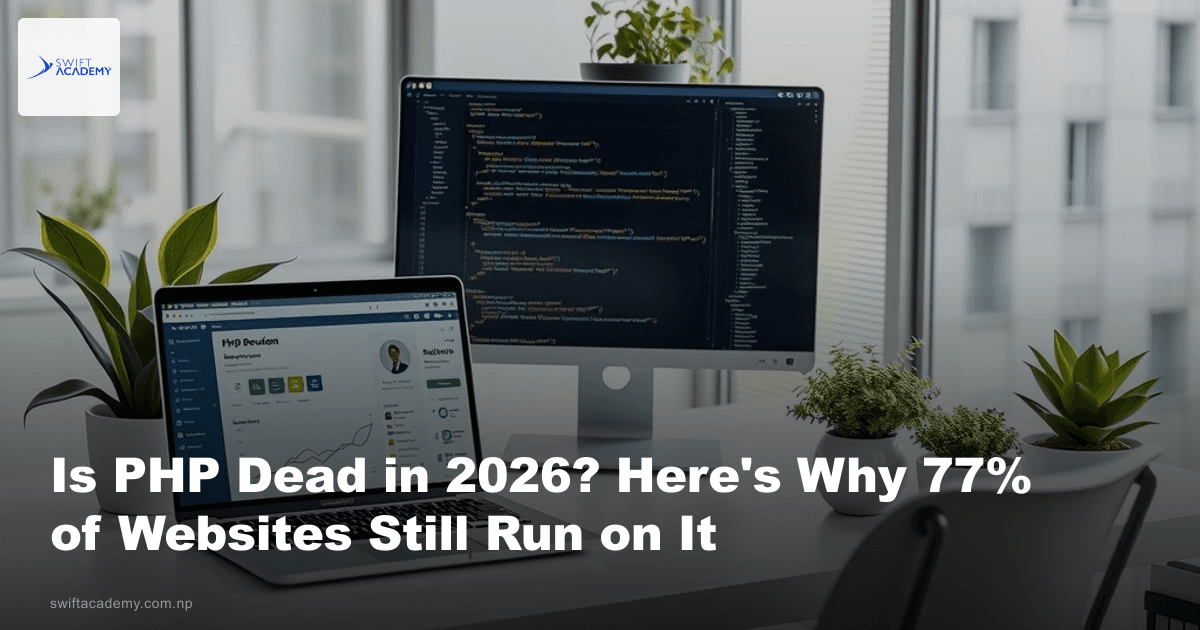
Every year since 2015, someone declares PHP dead. And every year, PHP continues to power the majority of the internet. In 2026, approximately 77% of all websites with a known server-side programming language still use PHP. WordPress alone, built entirely on PHP, runs over 40% of all websites worldwide. Yet the "PHP is dead" narrative persists, fueled by developers who equate popularity with quality and mistake Twitter trends for technology trends. If you are in Nepal considering a web development career and wondering whether PHP is worth learning, this article gives you the full picture: the data, the evolution, the job market, and the honest assessment of where PHP stands today.
Is PHP Actually Dying or Just Evolving?
PHP is not dying but actively evolving. PHP 8.4 introduced fibers, property hooks, and performance improvements that rival modern languages, while the Laravel ecosystem continues to attract new developers and enterprise adoption globally.
The "PHP is dead" argument typically comes from developers in ecosystems like Node.js, Python, or Go who compare modern PHP to the PHP 4 and 5 era code they remember. This is like comparing a 2026 car to a 1995 model and declaring cars dead.
Modern PHP looks nothing like the spaghetti code of the early 2000s. PHP 8.x introduced:
- Named arguments for cleaner function calls
- Match expressions replacing clunky switch statements
- Enums for type-safe value sets
- Fibers for asynchronous programming
- Readonly properties for immutable data
- Property hooks for computed properties
- Intersection types for advanced type safety
- JIT compilation for significant performance improvements
The language has also embraced strict typing, modern OOP patterns, and the PSR standards that make PHP codebases as clean and maintainable as any other modern language.
Laravel, the most popular PHP framework, has grown into a complete ecosystem with Livewire for reactive UIs, Inertia.js for SPA-like experiences, Forge for server management, Vapor for serverless deployment, and Reverb for WebSockets. This ecosystem maturity is a sign of a thriving technology, not a dying one.
Why Do 77% of Websites Still Use PHP?
The 77% figure reflects PHP's dominance through WordPress (40%+ of all sites), mature CMS platforms like Drupal and Joomla, massive platforms like Facebook and Wikipedia, and the enormous installed base of PHP applications worldwide.
Understanding why PHP maintains this market share requires looking at several factors:
| Factor | Impact |
|---|---|
| WordPress market share | 40%+ of all websites worldwide |
| Other PHP CMS (Drupal, Joomla) | Additional 5-7% of websites |
| Legacy enterprise applications | Millions of PHP apps in production |
| Hosting availability | Every shared host supports PHP |
| Developer availability | Millions of PHP developers globally |
| Laravel ecosystem growth | New enterprise adoption continues |
| E-commerce (WooCommerce, Magento) | Dominant in online retail |
The hosting argument alone is significant. PHP runs on virtually every web hosting provider, including the cheapest shared hosting plans. This accessibility means small businesses, bloggers, and organizations worldwide default to PHP-based solutions because they are affordable to host and easy to deploy.
WordPress deserves special attention. With over 40% of all websites running WordPress, the platform alone guarantees PHP's relevance for decades. Every WordPress theme, plugin, and customization requires PHP knowledge. The WordPress ecosystem generates billions of dollars annually and employs hundreds of thousands of developers worldwide.
In Nepal, PHP's dominance is even more pronounced. The majority of Nepali web development agencies use PHP, most local hosting providers optimize for PHP, and the freelance market is heavily weighted toward WordPress and Laravel projects.
How Does PHP 8.x Compare to Python, Node.js, and Other Languages?
PHP 8.x with JIT compilation matches or exceeds Node.js and Python in web request handling performance, while modern frameworks like Laravel provide developer experience comparable to Django and Express with superior deployment simplicity.
The comparison depends on what you are measuring:
| Criteria | PHP 8.x (Laravel) | Python (Django) | Node.js (Express/Next.js) |
|---|---|---|---|
| Web Request Performance | Excellent (JIT) | Good | Excellent |
| Learning Curve | Moderate | Easy | Moderate |
| Type Safety | Strong (8.x) | Moderate (typing) | Strong (TypeScript) |
| Ecosystem Maturity | Very Mature | Very Mature | Mature |
| Hosting Cost | Very Low | Moderate | Moderate |
| Job Market (Nepal) | Very Large | Growing | Large |
| Freelance Demand | Very High | Moderate | High |
| AI/ML Integration | Limited | Excellent | Moderate |
| Real-time Apps | Good (Reverb) | Good (Channels) | Excellent |
| CMS Ecosystem | Dominant | Limited | Growing |
PHP's genuine weaknesses are in areas like machine learning, data science, and highly concurrent real-time applications. For these use cases, Python and Node.js are clearly better choices. But for the vast majority of web development work, which involves building CRUD applications, e-commerce sites, content management systems, and business tools, PHP is not just adequate but excellent.
The deployment story is where PHP often wins. A Laravel application can be deployed to a $5/month shared hosting plan. A comparable Django or Node.js application typically requires a VPS starting at $10-20/month. For freelancers and small businesses in Nepal where cost matters enormously, this difference is significant.
What Does the PHP Job Market Look Like in Nepal?
PHP dominates Nepal's web development job market with the highest number of job postings, the largest freelance demand, and strong salary ranges from NPR 25,000 for juniors to NPR 150,000+ for senior Laravel developers.
The Nepali tech job market heavily favors PHP developers. Here is why:
-
Web agencies dominate the Nepali IT sector. Most IT companies in Nepal are web development agencies serving international clients. These agencies predominantly use PHP, either for WordPress projects or Laravel-based custom applications.
-
WordPress is everywhere in Nepal. Nepali businesses, from hotels in Pokhara to trekking companies to restaurants, need websites. WordPress is the default platform, and every WordPress project needs PHP developers.
-
Freelancing favors PHP. On Upwork, which is the primary freelancing platform used by Nepali developers, PHP and WordPress consistently rank among the top demanded skills. Laravel projects also command strong hourly rates.
| Role | Salary Range (NPR/month) | Demand Level |
|---|---|---|
| Junior PHP Developer | 25,000 – 40,000 | Very High |
| WordPress Developer | 30,000 – 55,000 | Very High |
| Laravel Developer (Mid) | 45,000 – 80,000 | High |
| Senior Laravel Developer | 80,000 – 150,000 | High |
| PHP/Laravel Freelancer | 60,000 – 300,000+ | Very High |
The demand for Laravel developers specifically is growing as Nepali companies transition from basic WordPress sites to custom web applications. Companies that previously outsourced to India or other markets are increasingly hiring locally, creating opportunities for well-trained PHP developers.
Should Beginners Still Learn PHP in 2026?
Yes, beginners should learn PHP if they want the fastest path to employment in Nepal's web development market, access to the largest freelance opportunity pool, and skills that apply to 77% of existing websites worldwide.
The choice of first programming language depends on your goals:
Choose PHP if:
- You want the fastest path to a paying web development job in Nepal
- You plan to freelance on platforms like Upwork or Fiverr
- You want to work with WordPress, WooCommerce, or existing PHP applications
- You prefer low-cost hosting and simple deployment
- You want maximum job availability in the Nepali market
Choose Python instead if:
- You are interested in AI, machine learning, or data science
- You want to work in academic or research settings
- You prefer a language used beyond web development
Choose JavaScript/TypeScript instead if:
- You want to do both frontend and backend with one language
- You are interested in real-time applications
- You want to build with React, Next.js, or similar frameworks
For most aspiring web developers in Nepal, PHP with Laravel offers the best combination of learning curve, job availability, freelance opportunity, and career growth potential. It is not the trendiest choice, but it is the most practical one for the Nepali market.
How Has Laravel Changed the Perception of PHP?
Laravel transformed PHP's reputation from "messy scripting language" to "elegant application framework" by introducing expressive syntax, convention-over-configuration patterns, a rich ecosystem of tools, and a vibrant community that rivals Rails and Django.
Before Laravel, PHP's reputation was largely deserved. The language encouraged bad practices, lacked conventions, and resulted in difficult-to-maintain codebases. Laravel changed everything.
Taylor Otwell released Laravel in 2011, and it has since become the most popular PHP framework by a wide margin. Here is what Laravel brought to PHP:
- Eloquent ORM: An elegant ActiveRecord implementation that makes database work intuitive
- Blade templating: Clean, powerful templating with component support
- Artisan CLI: Command-line tools for code generation, migrations, and more
- Built-in authentication and authorization: Secure user management out of the box
- Queue system: Background job processing for scalable applications
- Laravel Ecosystem: Forge, Vapor, Nova, Livewire, Inertia, Reverb, Cashier, and more
Laravel's influence has been so significant that many developers now identify as "Laravel developers" rather than "PHP developers," distancing themselves from PHP's historical baggage while benefiting from the language's continued evolution.
In Nepal, Laravel adoption has grown steadily. Companies that previously used raw PHP or CodeIgniter are migrating to Laravel for its maintainability and ecosystem. This creates demand for developers who know modern Laravel practices.
What the Reddit Community Says
The "Is PHP dead?" discussion appears on r/webdev and r/programming almost monthly. The most common response from experienced developers is some version of: "PHP is the COBOL of the web. It is not exciting, but it is everywhere and it is not going anywhere." On r/PHP, the community actively showcases modern PHP practices that would surprise critics, with posts about PHP 8 features regularly reaching the front page.
In r/Nepal, PHP and Laravel dominate discussions about web development careers. A recurring theme is experienced developers advising newcomers: "Learn Laravel if you want a job fast. Learn JavaScript if you want to work on cutting-edge projects. Ideally, learn both." One highly upvoted comment notes: "Every web agency in Kathmandu needs PHP developers. That is not changing in our lifetime."
On r/laravel, the community is notably positive and helpful, with developers sharing projects, packages, and tutorials. The framework's annual Laracon conferences continue to attract growing audiences, countering any notion that the community is shrinking.
Practical Takeaway
If you are deciding whether to learn PHP in 2026, here is the honest assessment:
Learn PHP (with Laravel) if you want to start earning as a web developer in Nepal within 3-6 months. The job market demand is real, the freelance opportunities are abundant, and the technology is mature and well-documented.
Do not learn PHP if your primary interest is in AI, mobile development, or cutting-edge frontend frameworks. PHP is a web-focused language, and while it excels in that domain, it does not extend well into other areas.
The ideal approach for a developer in Nepal is to learn PHP/Laravel as your first back-end stack for immediate employability, then add a second language (Python for AI or JavaScript for full-stack) to broaden your career options long-term.
PHP is not dead. It is not the most exciting language. But it is one of the most practical, employable, and financially rewarding skills you can learn as a web developer in Nepal in 2026.
Frequently Asked Questions
Will PHP still be relevant in 2030?
Yes. WordPress alone guarantees PHP's relevance for at least another decade. The WordPress ecosystem continues to grow, Laravel continues to evolve, and the installed base of PHP applications is too large to disappear. PHP's market share may slowly decrease, but it will remain a major web technology.
Is Laravel the only PHP framework worth learning?
Laravel is the most popular and has the largest ecosystem, but Symfony is also widely used in enterprise settings. CodeIgniter has a smaller but loyal user base. For most developers, starting with Laravel is the best choice because of its job market demand and comprehensive documentation.
Can PHP developers earn as much as Python or JavaScript developers in Nepal?
Senior Laravel developers can earn NPR 100,000-150,000+ per month, which is comparable to senior Python and JavaScript developers. For freelancing, PHP/WordPress skills often generate higher immediate income because of the volume of available projects.
Should I learn PHP 8 features or focus on Laravel first?
Learn PHP fundamentals including PHP 8 features alongside Laravel. Laravel uses many PHP 8 features internally, so understanding the language makes you a better Laravel developer. Spend about 2-3 weeks on PHP basics before starting Laravel.
Is WordPress development still profitable in 2026?
Very much so. Custom WordPress development, theme development, and plugin development remain highly profitable. The shift toward headless WordPress (using WordPress as a CMS with a separate frontend) has created new opportunities rather than reducing demand.
Master Modern PHP at Swift Academy
Ready to learn PHP the right way? Swift Academy's Laravel course in Pokhara teaches you modern PHP 8.x and Laravel development with real projects, REST API development, and deployment skills. Whether you want to land a job at a Nepali IT company or start freelancing on Upwork, our course gives you the practical skills employers demand. Visit swiftacademy.com.np or come to our Pokhara campus to enroll.
Related Articles
- Laravel vs CodeIgniter vs Symfony: Which PHP Framework Should You Choose?
- Building an E-Commerce Website with Laravel: Complete Step-by-Step Guide
- How to Start Freelancing with PHP Laravel: Land Your First Client in 30 Days
Suggested Images
- Alt: "Bar chart comparing PHP market share against Python Node.js and other server-side languages in 2026"
- Alt: "Timeline infographic showing PHP evolution from version 4 to PHP 8.4 with major feature additions"
- Alt: "Comparison table of PHP job demand versus other programming languages in Nepal tech market"