Laravel vs CodeIgniter vs Symfony: Which PHP Framework Should You Choose?
Choosing a PHP framework is one of the most consequential decisions you will make as a web developer. It shapes your career trajectory, determines which jobs you qualify for, and influences how quickly you can build applications. In Nepal's web development market, three PHP frameworks dominate the conversation: Laravel, CodeIgniter, and Symfony. Each has its strengths, its ideal use cases, and its community. This comparison goes beyond surface-level feature lists to give you an honest, experience-based analysis of all three frameworks so you can make the right choice for your specific goals, whether you are a student in Pokhara planning your first tech career or a working developer looking to switch frameworks.
Which PHP Framework Is Best for Beginners?
CodeIgniter is the easiest to learn with minimal configuration and a gentle learning curve, but Laravel is the best choice for beginners because its learning investment pays off with far greater career returns and ecosystem access.
The beginner-friendliness question has a nuanced answer. Let us compare the learning experience:
| Aspect | Laravel | CodeIgniter | Symfony |
|---|---|---|---|
| Initial Setup | Moderate (Composer) | Very Easy (download) | Complex (Composer + config) |
| Learning Curve | Moderate | Easy | Steep |
| Documentation Quality | Excellent | Good | Excellent but dense |
| Tutorial Availability | Abundant | Moderate | Limited |
| Time to First App | 2-3 days | 1-2 days | 5-7 days |
| Time to Production-Ready | 3-4 weeks | 2-3 weeks | 5-8 weeks |
CodeIgniter wins on pure simplicity. You can download it, extract it to a folder, and start building immediately. The configuration is minimal, the folder structure is intuitive, and the documentation is straightforward. For someone who just wants to understand MVC patterns quickly, CodeIgniter is the fastest path.
However, simplicity has costs. CodeIgniter's simplicity means you miss learning important concepts like dependency injection, service containers, middleware pipelines, and modern ORM patterns. When you later move to a more sophisticated framework or a non-PHP language, you have to learn these concepts from scratch.
Laravel's learning curve is steeper but more valuable. Learning Laravel teaches you software architecture patterns that transfer to Django, Spring Boot, ASP.NET, and other enterprise frameworks. The Artisan CLI, Eloquent ORM, Blade templating, and middleware system are not just Laravel features; they are implementations of universal software engineering concepts.
Symfony has the steepest learning curve by far. It is designed for experienced developers and uses explicit configuration that can overwhelm beginners. Unless you are already comfortable with PHP and object-oriented programming, Symfony is not the right starting point.
Our recommendation for beginners in Nepal: Start with Laravel. The extra effort in the first few weeks pays enormous dividends in career opportunities and skill transferability.
How Do Laravel, CodeIgniter, and Symfony Compare in Performance?
CodeIgniter delivers the fastest raw performance with minimal overhead, Symfony is highly performant with proper caching, and Laravel sacrifices some speed for developer productivity, though the difference is negligible for 95% of real-world applications.
Performance comparisons between frameworks are among the most misleading benchmarks in web development. Here is why, and what the actual numbers look like:
| Benchmark | Laravel | CodeIgniter 4 | Symfony |
|---|---|---|---|
| Simple JSON Response | ~850 req/s | ~1,400 req/s | ~950 req/s |
| Database Query (10 rows) | ~620 req/s | ~1,100 req/s | ~700 req/s |
| Full Page Render (template) | ~450 req/s | ~900 req/s | ~550 req/s |
| Memory Usage (baseline) | ~18 MB | ~8 MB | ~16 MB |
Benchmarks are approximate and vary significantly based on hardware, PHP version, and configuration.
CodeIgniter is clearly fastest in raw benchmarks. Its lightweight nature means less overhead per request. For simple applications, this difference is measurable.
But here is what benchmarks do not tell you:
-
Real-world bottlenecks are not framework overhead. Database queries, external API calls, and business logic consume 95%+ of request time. Whether your framework adds 2ms or 5ms of overhead is irrelevant when your database query takes 50ms.
-
Laravel and Symfony have superior caching. With proper caching (Redis, route caching, config caching), both frameworks can match or exceed CodeIgniter's performance in production.
-
Scalability is not about raw speed. Laravel's queue system, Symfony's event system, and their respective caching layers make them better suited for high-traffic applications even though CodeIgniter wins basic benchmarks.
For Nepali web applications that typically serve hundreds to thousands of users, not millions, framework performance differences are completely irrelevant. Choose based on features, ecosystem, and job market, not benchmarks.
Which Framework Has the Best Ecosystem and Tools?
Laravel has the richest ecosystem with official tools for every need including deployment (Forge), serverless (Vapor), real-time (Reverb), admin panels (Nova), and billing (Cashier), making it the most complete full-stack solution among PHP frameworks.
The ecosystem comparison is where Laravel's dominance becomes most apparent:
| Tool Category | Laravel | CodeIgniter | Symfony |
|---|---|---|---|
| ORM | Eloquent (excellent) | CI Model (basic) | Doctrine (powerful) |
| Templating | Blade | CI Views | Twig |
| CLI Tool | Artisan | Spark | Console |
| Authentication | Built-in (Breeze, Jetstream) | Third-party | Security Bundle |
| API Development | Built-in + Sanctum | Basic | API Platform |
| Queue/Jobs | Built-in | Third-party | Messenger |
| Real-time | Reverb (WebSocket) | Third-party | Mercure |
| Testing | PHPUnit + built-in helpers | PHPUnit | PHPUnit + built-in helpers |
| Admin Panel | Nova, Filament | Third-party | EasyAdmin |
| Deployment | Forge, Vapor, Envoyer | Manual | Manual |
| Payment | Cashier (Stripe) | Third-party | Third-party |
Laravel's ecosystem is unmatched in the PHP world. Official packages cover authentication, authorization, API development, billing, notifications, broadcasting, file storage, search, and more. Third-party packages on Packagist number in the thousands. Laracasts provides video tutorials for practically every Laravel feature.
Symfony's ecosystem is strong in different ways. Symfony components are used as building blocks throughout the PHP ecosystem, including within Laravel itself. Doctrine ORM is more powerful than Eloquent for complex database schemas. API Platform is the best tool for building REST and GraphQL APIs in PHP. However, Symfony's ecosystem requires more configuration and expertise to leverage effectively.
CodeIgniter's ecosystem is the smallest of the three. While the core framework is solid, you will frequently need to find or build third-party solutions for features that Laravel and Symfony include out of the box. This can be an advantage for learning (you understand how everything works) but a disadvantage for productivity.
Which Framework Has the Most Jobs in Nepal?
Laravel has the highest job demand in Nepal's web development market, followed by CodeIgniter which still has significant legacy usage, while Symfony jobs are rare in Nepal but available through remote international positions.
The Nepali job market for PHP frameworks reflects both global trends and local realities:
| Framework | Job Postings (Nepal) | Freelance Demand | Salary Range (NPR/month) |
|---|---|---|---|
| Laravel | Very High | Very High | 35,000 – 150,000 |
| CodeIgniter | Moderate (declining) | Moderate | 25,000 – 80,000 |
| Symfony | Low (mostly remote) | Low-Moderate | 50,000 – 200,000 |
Laravel dominance: Most new PHP projects in Nepal use Laravel. IT companies in Kathmandu and Pokhara list Laravel as a required skill more than any other PHP framework. Freelance clients on Upwork increasingly specify Laravel for custom web applications.
CodeIgniter's legacy: Many existing Nepali web applications were built with CodeIgniter, especially those developed between 2010 and 2018. These applications need maintenance and occasional feature additions, creating ongoing demand for CodeIgniter developers. However, new CodeIgniter projects are declining.
Symfony's niche: Few companies in Nepal use Symfony directly, but international companies hiring remote developers often require Symfony skills. Symfony jobs typically pay more because the framework is common in enterprise settings and the developer pool is smaller.
The practical advice: Learn Laravel as your primary framework. If you encounter CodeIgniter at a job, the transition is straightforward since CodeIgniter is simpler. If you want to work remotely for European companies, add Symfony to your skills later, as it is particularly popular in France, Germany, and other European markets.
When Should You Choose Each Framework?
Choose Laravel for most projects due to its balance of features and productivity, CodeIgniter for lightweight applications or when working with legacy systems, and Symfony for complex enterprise applications requiring maximum flexibility and customization.
Here are specific scenarios and the recommended framework for each:
Choose Laravel when:
- Building a new web application of any size
- You need authentication, API endpoints, or real-time features
- Working on e-commerce, SaaS, or content management projects
- You want rapid development with comprehensive tooling
- Building MVPs or prototypes that need to scale
- Freelancing for clients who need custom web applications
Choose CodeIgniter when:
- Maintaining or extending an existing CodeIgniter application
- Building a very simple application with minimal requirements
- Working on a project with strict performance constraints on limited hosting
- Learning MVC concepts for the first time (then move to Laravel)
- The project has no need for advanced features like queues or real-time
Choose Symfony when:
- Building large-scale enterprise applications with complex business logic
- Working on projects that require maximum customization and control
- Building microservices that need lightweight, independent components
- Working with a team experienced in Symfony
- Targeting European company clients or remote positions
Can You Switch Between Frameworks Easily?
Switching from CodeIgniter to Laravel is relatively easy and takes 2-4 weeks of focused learning, while switching between Laravel and Symfony requires understanding different architectural philosophies but shares many underlying concepts through Symfony components.
The transferability of skills between PHP frameworks is higher than most developers expect:
CodeIgniter to Laravel: This is the most common transition in Nepal. CodeIgniter developers already understand MVC, routing, and database interactions. The main learning areas are Eloquent ORM (vs. CI's simpler model), Blade templating, Artisan CLI, middleware, and service container concepts. Most developers become productive in Laravel within 2-3 weeks.
Laravel to Symfony: Laravel actually uses many Symfony components internally (HttpFoundation, Console, Routing, etc.). The conceptual leap is understanding Symfony's more explicit configuration approach versus Laravel's convention-over-configuration philosophy. Developers comfortable with Laravel can learn Symfony in 4-6 weeks.
Symfony to Laravel: Symfony developers transitioning to Laravel typically find it refreshingly easy. Laravel's "magic" and conventions feel like shortcuts after Symfony's explicit approach. The main adjustment is learning Laravel-specific tools like Eloquent and Blade. This transition takes about 2 weeks.
The underlying PHP skills, including OOP, design patterns, database management, and API development, transfer completely between all three frameworks. This is why your choice of first framework matters less than your depth of understanding.
What the Reddit Community Says
The Laravel vs CodeIgniter vs Symfony debate generates passionate discussions across Reddit. On r/PHP, the consensus leans heavily toward Laravel for most developers: "Laravel is the right choice 80% of the time. Symfony for the other 20%. CodeIgniter for maintaining legacy projects." However, experienced Symfony developers push back, arguing that Symfony's explicit approach creates more maintainable long-term codebases.
On r/laravel, users frequently share their transition stories from CodeIgniter: "I spent three years on CodeIgniter and thought it was fine. Then I learned Laravel and realized how much time I had been wasting building things that Laravel provides out of the box." This sentiment is common among developers who make the switch.
In r/Nepal, the framework discussion is more practical. Users consistently report that Laravel skills are the most in-demand for PHP jobs in Nepal. One commenter shared: "I applied to 15 web development jobs in Kathmandu. 12 of them required Laravel. Two wanted CodeIgniter. One wanted Symfony." Another noted that CodeIgniter knowledge is still valuable for agencies maintaining older client sites.
Practical Takeaway
For developers in Nepal in 2026, the recommendation is clear:
-
Learn Laravel as your primary PHP framework. It has the best job market, the richest ecosystem, and teaches transferable software engineering concepts.
-
Familiarize yourself with CodeIgniter basics. You may encounter it in existing projects. A weekend of study is enough to understand its structure and work with existing CodeIgniter codebases.
-
Consider Symfony as an advanced skill. Once you are comfortable with Laravel, learning Symfony opens doors to remote work with European companies and enterprise positions.
-
Do not let framework debates paralyze you. Picking any framework and building real projects is infinitely more valuable than spending months comparing frameworks without writing code.
The best framework is the one you know well enough to build real applications with. Start with Laravel, build projects, get hired, and add other frameworks to your toolkit as your career demands.
Frequently Asked Questions
Can I learn Laravel without knowing PHP first?
You should know PHP basics before starting Laravel. Spend 2-3 weeks learning PHP fundamentals including variables, functions, arrays, OOP basics, and string manipulation. Then start Laravel, learning advanced PHP concepts through the framework.
Is CodeIgniter dead?
CodeIgniter is not dead, with CodeIgniter 4 being a significant modernization. However, its market share and community are shrinking relative to Laravel. It remains useful for legacy maintenance and lightweight applications.
Which framework should I choose for a startup in Nepal?
Laravel. Its rapid development capabilities, comprehensive ecosystem, and ability to scale make it ideal for startups that need to build quickly and iterate. Most Nepali startups in 2026 choose Laravel for their web backends.
Does Symfony pay more than Laravel in Nepal?
Symfony jobs are rarer in Nepal but tend to pay 20-30% more when available, primarily through remote positions with international companies. Laravel has far more job availability overall.
Can I build a mobile app backend with any of these frameworks?
Yes, all three can serve as API backends for mobile apps. Laravel with Sanctum is the most popular choice for mobile APIs in the PHP world, offering simple token-based authentication and well-documented API resource patterns.
Learn Laravel the Right Way at Swift Academy
Ready to master the PHP framework that Nepali employers demand most? Swift Academy's Laravel course in Pokhara takes you from PHP basics through advanced Laravel development with real-world projects, API development, and deployment. Our instructors are working developers who teach the practical skills that get you hired. Visit swiftacademy.com.np or come to our Pokhara campus to start your Laravel journey.
Related Articles
- Is PHP Dead in 2026? Here's Why 77% of Websites Still Run on It
- Building an E-Commerce Website with Laravel: Complete Step-by-Step Guide
- How to Start Freelancing with PHP Laravel: Land Your First Client in 30 Days
Suggested Images
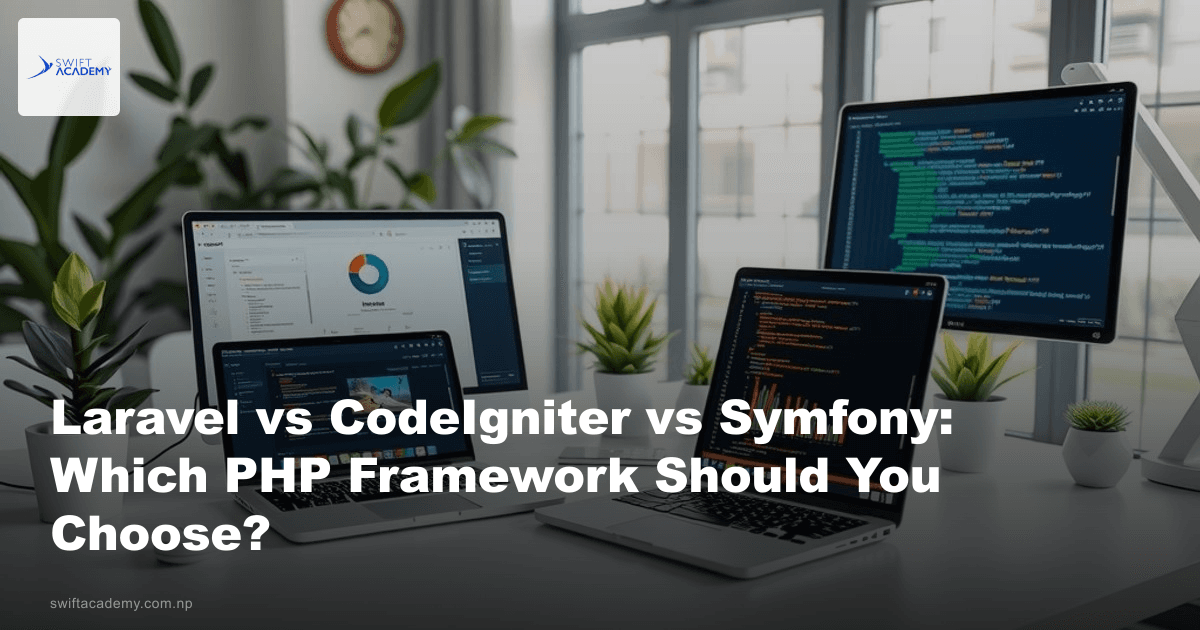
- Alt: "Side by side comparison of Laravel CodeIgniter and Symfony code structure and project organization"
- Alt: "Bar chart comparing job demand for Laravel CodeIgniter and Symfony frameworks in Nepal 2026"
- Alt: "Feature comparison table showing Laravel vs CodeIgniter vs Symfony ecosystem tools and capabilities"